
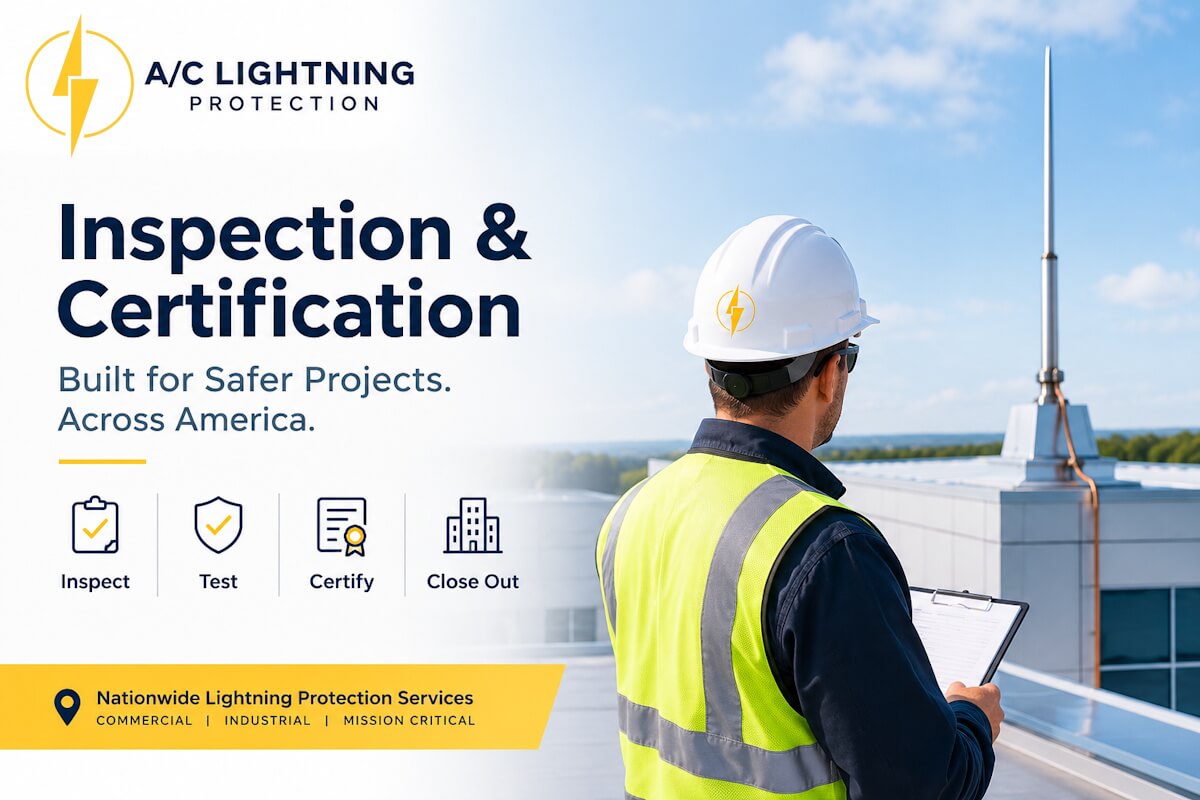
Completing a commercial construction project involves more than finishing the installation. Contractors must also coordinate inspections, verify applicable requirements, resolve outstanding deficiencies, and assemble the documentation needed for project closeout.
A lightning protection system inspection helps project teams evaluate an installed system against the applicable design documents, project specifications, and governing installation requirements. Depending on the project, a formal inspection or certification process may also be necessary before the system can be accepted.
For electrical contractors, general contractors, architects, engineers, and construction project managers, understanding these requirements early can help reduce avoidable coordination problems and documentation gaps.
A/C Lightning Protection provides commercial and industrial lightning protection services across the United States, supporting projects that require experienced coordination from design and installation through inspection-related activities and project completion.
If your team is planning a new installation, completing a commercial building, or coordinating a mission-critical facility, this guide explains what to prepare before a lightning protection inspection, how certification fits into the process, and what to consider before closing out the project.
Planning a U.S. Commercial Lightning Protection Project?
Discuss your project specifications, lightning protection installation needs, and service requirements with our nationwide team.
What Is a Lightning Protection System Inspection?
A lightning protection system inspection is an evaluation of an installed system against the applicable requirements established for a particular project. Its scope may include reviewing installation details, system components, relevant connections, approved drawings, and supporting documentation.
The exact inspection process depends on the applicable standard, project specifications, inspection program, and authority having jurisdiction where relevant.
For contractors, the objective is to identify whether the installed work meets the criteria that apply to the project and whether any outstanding items must be addressed before acceptance or certification.
What Does a Lightning Protection Inspection Evaluate?
Depending on the project requirements, an inspection may consider:
- Air terminals and their placement in relation to the approved design.
- Lightning protection conductors, connections, and routing.
- Bonding and grounding provisions where applicable.
- Relevant component identification and installation details.
- Installation records and approved changes to the original design.
- Test results and other supporting documentation when required.
- Deficiencies that need correction or further review.
This is not a universal checklist for every building. The responsible inspection organization should determine the applicable inspection scope using the governing requirements and project documentation.
What Is the Difference Between Inspection, Testing, and Certification?
Although these terms are often used together, they describe different activities.
Inspection evaluates the installed system against the applicable criteria within the defined scope.
Testing involves specified procedures used to assess particular system characteristics when required by the design, standard, or inspection program.
Certification is a formal determination or documented status issued under an applicable certification program after its requirements have been satisfied.
A contractor’s internal quality-control inspection does not automatically constitute independent certification. Likewise, completing a test does not, by itself, establish that an entire lightning protection system satisfies every applicable requirement.
Understanding these differences helps project teams assign responsibilities correctly and avoid confusion during final acceptance.
For broader project support, explore A/C Lightning Protection’s lightning protection inspection and related services.
When Should Lightning Protection Inspection Take Place on a Construction Project?
Inspection requirements should be considered during design and preconstruction, not introduced for the first time when the project is nearly complete.
Early coordination allows the construction team to establish responsibilities, identify relevant inspection stages, and plan access to installed components before work becomes concealed or difficult to verify.
Inspection Planning During Design and Preconstruction
Before installation begins, the project team should review the contract documents and clarify the lightning protection system’s scope.
Key questions include:
- Which installation standard or project specification applies?
- Which edition or requirements have been adopted or specified?
- Is a formal third-party inspection or certification required?
- Who is responsible for arranging inspections and coordinating corrections?
- What records must be submitted for project closeout?
- Are there specific inspection stages that must occur before other construction activities proceed?
Architects, engineers, specifiers, electrical contractors, and general contractors should establish these responsibilities early enough to incorporate them into the construction schedule.
Where requirements remain unclear, the team should obtain clarification from the design professional, owner, authority having jurisdiction, or applicable inspection organization.
Inspection During Installation and Before Concealed Work
Some installation details may become inaccessible after roofing, finishes, equipment, or other building elements are completed.
Where the governing requirements or inspection program call for earlier verification, contractors should coordinate those inspection points before the relevant work is concealed.
The installation team should also maintain appropriate records of approved field changes and completed work.
Planning ahead can help prevent situations in which a project team must reopen finished areas or reconstruct installation details to address an information gap.
Final Inspection Before Project Closeout
As the project approaches completion, the responsible parties should confirm that the required installation work, inspection activities, corrective actions, and documentation are complete.
Depending on the project, this may involve:
- Reviewing the installed system against approved documents.
- Confirming that required inspection stages have been completed.
- Addressing documented deficiencies.
- Gathering applicable testing and installation records.
- Coordinating any required independent inspection or certification.
- Submitting the documentation specified in the contract.
The exact sequence varies by project. Contractors should confirm the applicable requirements rather than assume that every system follows an identical approval process.
Need Lightning Protection Inspection or Certification Support?
Coordinate inspection, testing, installation verification, and project closeout requirements for your U.S. commercial or industrial project.
What Should Contractors Prepare Before a Lightning Protection Inspection?
Preparation is one of the most practical ways to improve inspection coordination. A project team that can provide the relevant drawings, records, access, and scope information is better positioned to address questions efficiently.
The following lightning protection inspection checklist is a planning aid. It should be adapted to the specific project and must not replace the official requirements of the applicable standard or certification program.
1. Approved Drawings and Project Specifications
Gather the documents that establish what the system was designed and contracted to include.
These may include:
- Approved lightning protection drawings.
- Relevant project specifications and scope-of-work documents.
- Applicable installation standards and required editions.
- Approved submittals and changes.
- Relevant design clarifications and field-change approvals.
The inspection team needs to understand the criteria against which the installed system is being evaluated.
If field conditions differ from the original design, the contractor should identify the changes and confirm that they have been reviewed and approved by the responsible party where required.
2. Installation and Component Records
Organize the available records that demonstrate how the system was installed.
Depending on the project, these may include installation quality-control records, component identification, product documentation, approved substitutions, and records of corrective work.
Ensure that the information is consistent with the actual installation and the applicable documentation requirements.
Contractors should not assume that possessing product documentation alone demonstrates that the completed system meets all installation requirements.
3. Site Access and Installation Visibility
Coordinate access to relevant portions of the system before the inspection takes place.
The project team should identify roof access arrangements, restricted areas, concealed work, and any site-specific safety procedures that affect inspection planning.
Where components are no longer visible, available installation records or earlier inspection documentation may be relevant. Whether that evidence is sufficient depends on the applicable requirements and the inspection organization’s determination.
Clear communication between the general contractor, electrical contractor, roofing contractor, and lightning protection specialist can help avoid unnecessary scheduling conflicts.
4. Grounding, Bonding, and Testing Records
Gather the relevant records for grounding, bonding, continuity, or other testing where those activities are required by the project specification or applicable inspection scope.
Documentation should accurately identify the work or test performed and provide the results and supporting details required by the governing procedure.
Do not apply a universal test method or acceptance threshold to every lightning protection system. The appropriate procedure depends on the system design, applicable requirements, and the purpose of the test.
5. Inspection and Closeout Responsibilities
Before the scheduled inspection, confirm who is responsible for each deliverable.
For example, the electrical contractor may coordinate site access, the lightning protection installer may provide installation records, the general contractor may manage the project closeout schedule, and the designated inspection organization may handle its own inspection report or certification documentation.
These responsibilities should be established in the contract documents and project coordination process rather than assumed.
Which Standards and Project Requirements Govern Lightning Protection Inspection?
The correct inspection criteria depend on the project. U.S. construction teams should identify the applicable code provisions, installation standards, contract requirements, and any required certification program before finalizing the inspection plan.
Two important references in U.S. lightning protection work are NFPA 780 and UL 96A. They serve related but distinct roles, and the edition applicable to a particular project must be verified.
NFPA 780 and Lightning Protection Installation Requirements
NFPA 780, Standard for the Installation of Lightning Protection Systems, provides requirements for lightning protection system installation.
The National Fire Protection Association lists the 2026 edition as the current edition of NFPA 780. However, the latest published edition is not automatically the edition adopted by every jurisdiction or incorporated into every contract.
Contractors and design professionals should confirm the edition applicable to their project and review the relevant provisions with the responsible design professional or authority having jurisdiction.
A reference to NFPA 780 alone does not establish that every project has the same inspection, testing, or certification obligations.
UL 96A and Lightning Protection System Inspection
UL 96A, Standard for Installation Requirements for Lightning Protection Systems, addresses installation requirements for lightning protection systems within its scope.
UL Solutions also operates a lightning protection inspection and Master Label Certificate program. Where this program applies, its inspection process and required documentation should be coordinated with the responsible organization.
Contractors should distinguish between installing a system to the specified requirements and obtaining a formal inspection or certificate through an applicable program.
The need for a particular certification depends on the governing code, contract documents, owner requirements, and applicable inspection arrangements.
Confirm the Applicable Standard and Certification Scope
Before proceeding, the project team should establish:
- The standard and edition required for the project.
- Whether local code adoption or contract language adds specific requirements.
- Whether independent inspection or certification is required.
- Which organization is authorized to perform the required inspection or issue the relevant certificate.
- What records must be provided before the project can be considered complete.
For more detailed background, review A/C Lightning Protection’s guide to UL 96A vs. NFPA 780 and its lightning protection specifications and project resources.
Ready to Discuss Your Lightning Protection Project?
Connect with A/C Lightning Protection to discuss your project scope, installation requirements, and inspection coordination needs across the USA.
What Happens If a Lightning Protection System Inspection Identifies Deficiencies?
An inspection finding does not automatically mean the entire system must be replaced. The appropriate response depends on the nature of the finding, the applicable requirements, and the decision of the responsible design or inspection organization.
For contractors, the priority is to understand the finding, determine who must address it, complete any required corrective work, and document the resolution.
Document the Inspection Findings
The project team should obtain and review the relevant findings or inspection report.
Each item should be clear enough for the responsible party to understand the location, nature of the issue, and action needed to resolve it.
Where clarification is required, the contractor should consult the appropriate technical or inspection representative before proceeding with corrective work.
Complete the Required Corrective Work
Assign each corrective item to the responsible party and coordinate the work with other construction activities.
Depending on the finding, the response may involve installation corrections, approved design clarification, additional documentation, or other actions required by the governing criteria.
Changes should be reviewed and approved by the responsible party where necessary. Contractors should not independently alter the system in a way that conflicts with approved drawings or applicable requirements.
Arrange Follow-Up Inspection Where Required
After corrective work is complete, determine whether additional inspection, testing, documentation, or formal acceptance is required.
The project team should retain the relevant correction records and confirm that outstanding items have been addressed through the process specified by the applicable inspection program.
Clear tracking of findings and resolutions helps contractors communicate progress to general contractors, owners, and other project stakeholders.
What Documentation May Be Needed for Lightning Protection Project Closeout?
A complete lightning protection project closeout package should reflect the actual contract requirements and the documentation required by the applicable inspection or certification program.
There is no single universal document package that applies to every commercial building or industrial facility.
Inspection Reports and Corrective-Action Records
Where applicable, retain inspection reports, documented findings, records of corrective work, and evidence that required follow-up actions have been completed.
These records help the project team establish what was inspected, which items required attention, and how outstanding issues were resolved.
As-Built Drawings and Installation Records
Where required by the contract, maintain updated drawings that reflect approved field changes and the final installed configuration.
Relevant installation records, approved deviations, and supporting documentation should be organized so that the owner or designated project representative can review the completed work.
Certification and Final Acceptance Documentation
If the project requires formal certification, confirm which organization issues the certificate and what conditions must be met before it can be issued.
A certification document, an installation completion record, an inspection report, and a contractor’s statement of work performed are not necessarily interchangeable.
The project team should verify that the correct deliverable has been received and that its scope matches the contract requirements.
A Practical Closeout Checklist for Contractors
Before marking the lightning protection scope complete, confirm the following items where applicable:
- The approved drawings and relevant specifications are available.
- Required installation and inspection stages have been completed.
- Applicable testing records have been collected.
- Required inspection findings have been resolved.
- Approved changes and relevant as-built records have been documented.
- Required inspection reports and certification documents have been received.
- Outstanding responsibilities have been clarified with the general contractor or owner.
This checklist is intended as a project coordination tool. The governing contract documents and inspection program determine the final closeout requirements.
Need a Lightning Protection Installation Partner?
Partner with our team for commercial lightning protection installation and project coordination on construction projects across the United States.
Which Commercial and Industrial Projects Need Inspection Coordination?
Lightning protection inspection planning is relevant to a wide range of commercial and industrial construction projects. The details depend on the facility, system design, applicable requirements, and owner expectations.
Commercial Buildings and Large Construction Projects
Commercial construction projects may involve multiple contractors, design professionals, and subcontractors working to a shared completion schedule.
Early coordination helps the team identify the lightning protection scope, confirm inspection responsibilities, and avoid leaving required documentation until the end of construction.
For electrical contractors and general contractors, clear responsibility assignments are particularly important when the system is installed alongside roofing, structural, electrical, and other building work.
Data Centers and Mission-Critical Facilities
Data centers and other mission-critical facilities require careful coordination among design teams, contractors, facility stakeholders, and project management teams.
Lightning protection work should be aligned with the approved design, facility requirements, applicable standards, and required project documentation.
For these projects, contractors should clarify inspection milestones, access requirements, testing responsibilities, and certification deliverables early in the schedule.
Explore A/C Lightning Protection’s dedicated data center lightning protection services to learn more about the company’s work in this sector.
Manufacturing, Industrial, Healthcare, and Institutional Facilities
Manufacturing plants, healthcare facilities, warehouses, educational institutions, and other large facilities may have different design conditions, operating requirements, and construction constraints.
The inspection plan should reflect the actual project rather than rely on a generic approach.
Where the facility has restricted access, specialized equipment, or operational limitations, contractors should coordinate the inspection schedule and documentation requirements with the relevant project stakeholders.
How to Select a Lightning Protection Inspection and Certification Provider
Selecting the appropriate provider begins with understanding what the project requires. Not every contractor, installer, inspection organization, or certification body performs the same role.
Before engaging a provider, confirm the scope of work, relevant experience, qualifications, and any required authorization under the applicable certification program.
Verify Relevant Qualifications and Inspection Capabilities
Ask prospective providers about their experience with the type of building, system, and project requirements involved.
Where independent certification is required, verify that the organization responsible for issuing the certificate is authorized to perform that work under the relevant program.
Do not assume that a contractor’s installation credentials automatically authorize it to issue an independent third-party certificate.
Confirm Familiarity With Project Specifications and Standards
The provider should understand the applicable project requirements and the deliverables needed for the intended inspection or certification process.
Discuss the relevant standards, inspection stages, documentation, site access, and responsibility for resolving findings before work is scheduled.
This helps the construction team understand what the provider will evaluate and what remains the responsibility of other parties.
Coordinate Installation, Inspection, and Closeout Responsibilities
Where possible, establish the division of responsibilities between the design professional, general contractor, electrical contractor, lightning protection installer, owner, and inspection organization.
A clear scope should address scheduling, installation records, required tests, corrective work, and final documentation.
A/C Lightning Protection supports commercial and industrial lightning protection projects through its nationwide service capabilities. If your team needs assistance with an upcoming project, review ACLP’s lightning protection solutions and discuss your requirements with the company.
Coordinate Your Lightning Protection Inspection Before Project Closeout
Lightning protection inspection and certification should be planned as part of the construction process—not left until the project is ready for final handover.
For electrical contractors, general contractors, architects, engineers, and project managers, early coordination helps clarify inspection responsibilities, documentation requirements, and the steps needed to resolve outstanding items.
A/C Lightning Protection provides commercial and industrial lightning protection services across the United States. Whether your team is planning a new construction project, coordinating an installation, or preparing for closeout, aligning the work with the applicable project requirements is an important step toward an organized completion process.
Planning a commercial or industrial lightning protection project?
Contact A/C Lightning Protection to discuss your project scope, installation requirements, and inspection coordination needs.
Frequently Asked Questions About Lightning Protection Inspection
What Is Included in a Lightning Protection System Inspection?
A lightning protection system inspection evaluates the installed system against the applicable project requirements and defined inspection scope. Depending on the project, it may include reviewing components, installation details, relevant connections, grounding or bonding provisions, drawings, and supporting records. The exact scope depends on the governing requirements and inspection program.
Is Lightning Protection Inspection the Same as Certification?
No. Inspection is an evaluation of the installed system, while certification is a formal determination or documented status issued under an applicable program. A contractor’s internal inspection does not automatically provide independent certification. Contractors should confirm whether their project requires a separate inspection or certification process.
Does Every Lightning Protection System Require UL Certification?
Not necessarily. The applicable requirements depend on adopted codes, project specifications, owner requirements, and the relevant inspection or certification program. Some projects may require a formal third-party inspection or certificate, while others may have different documentation and acceptance requirements. Contractors should verify the exact obligation before scheduling the inspection.
What Documents Should Contractors Prepare Before a Lightning Protection Inspection?
Depending on the project, contractors may need approved drawings, specifications, relevant component information, installation records, approved field changes, applicable testing records, and required closeout documents. The project team should confirm the exact list with the responsible inspection organization and the contract documents rather than assume that every project uses the same checklist.
What Happens If a Lightning Protection Inspection Identifies a Deficiency?
The responsible parties should review the finding, determine the required corrective action, and document the resolution. Depending on the issue and the applicable program, follow-up inspection, testing, or additional documentation may be required. Contractors should confirm that all outstanding items have been addressed before treating the relevant inspection or certification process as complete.


